





Your sales forecast is a coin toss. Actually, with the average success rate for forecasted deals sitting at just 47 percent, the coin has better odds. Most leaders think they have a data problem. They don't. They have an execution problem. You've spent millions on CRM seats and dashboards, yet your...
Your sales forecast is a coin toss. Actually, with the average success rate for forecasted deals sitting at just 47 percent, the coin has better odds. Most leaders think they have a data problem. They don't. They have an execution problem. You've spent millions on CRM seats and dashboards, yet your reps still ignore the playbook and complex deals continue to slip through the cracks. True enterprise sales process optimization isn't about cleaner reporting or passive intelligence that narrates your failures after the fact. It's about the mechanics of the win.
You're tired of coaching based on gut feelings and watching high-stakes opportunities vanish into the void. It's time to stop fixing your data and start fixing your deals. This guide provides an execution-first roadmap to optimizing complex sales processes in 2026. For organizations seeking to overcome growth obstacles through strategic guidance and execution support, Top7 offers the expertise needed to turn strategy into results. We'll show you how to move from passive enablement to active execution, ensuring your strategy actually lives in every rep's daily behavior. We're going to dive into bridging the execution gap, implementing real-time deal guidance, and finally securing the predictable revenue growth your board demands.
• Stop mistaking more data for better results. Real optimization is a behavioral shift, not just another dashboard for your managers to ignore.
• Master enterprise sales process optimization by identifying the "Execution Gap" where your high-level strategy dies during actual deal interactions.
• Shift from passive enablement to active execution. It's time to move beyond telling reps "what" to sell and start enforcing "how" to win.
• Replace vanity metrics with leading indicators that actually matter. Measure deal health and strategy adherence instead of just counting activities.
• Discover why revenue intelligence isn't enough in 2026 and how real-time deal guidance bridges the gap between your strategy and their reality.
Most leaders treat enterprise sales process optimization like a math problem. They think if they just buy more intelligence or enrich their data one more time, the revenue will magically appear. It won't. Optimization is not a dashboard. It is a behavioral shift. If your reps aren't changing what they do in the heat of a deal, you aren't optimizing; you're just watching yourself fail in higher resolution. You don't need more data points to tell you why you lost. You need a system that ensures you win.
We see it everywhere. A company spends millions on a top-tier strategy, but that $10 million vision dies a quiet death inside a $100,000 deal because the rep went rogue. This is the Execution Gap. It's the distance between what your playbook says and what actually happens on a Tuesday morning Zoom call. Most optimization efforts are just rearranging the deck chairs on the Titanic. You're refining sales stages and renaming pipeline categories while the ship is sinking because nobody is actually following the instructions. Clean data in a broken process just helps you fail faster. It doesn't fix the underlying rot.
The fundamental mistake is confusing tracking with guiding. Tracking tells you that you lost the deal three weeks ago. Guiding ensures you don't lose it today. One is an autopsy; the other is a surgery. If you want results, you have to stop looking at what happened and start dictating what should happen next. True optimization happens at the deal level, not the report level.
Inconsistent execution is the silent killer of predictable revenue. When every rep interprets your process as a loose suggestion, your forecast becomes a black hole. You can't predict growth because you can't control behavior. This isn't just about lost revenue; it's about brand equity. When a rep ignores the playbook, they aren't just missing a quota. They're delivering a fragmented, unprofessional experience to your most valuable prospects. Your process must be a system, not a suggestion. Without standardized excellence, you're left with a team of "lone wolves" who are impossible to coach and even harder to scale.
CRMs were built for managers, not for sellers. They are systems of record designed to look backward. They demand a "data entry tax" that reps hate, creating friction that leads to even more rogue behavior. Reps don't need another place to log notes; they need a guide that tells them exactly how to move the deal forward. Moving from a System of Record to a System of Execution is the only way to bridge the gap. If the technology doesn't make the rep's job easier by providing high-quality deal guidance, they will ignore it. Every time. Stop building graveyards for dead data and start building engines for live execution.
Most organizations confuse giving reps tools with making sure they actually use them. Enablement gives your team the "what." It is a library of content, a stack of PDFs, and a series of training videos that everyone forgets by Friday. Execution ensures the "how." It is the difference between handing a pilot a flight manual and providing an active autopilot system that corrects for turbulence in real-time. In 2026, enterprise sales process optimization demands a move away from passive support toward active intervention.
The industry is hitting a wall with "Revenue Intelligence." Why? Because it is passive tracking. It records the funeral; it doesn't save the patient. You don't need a transcript of why a rep missed a critical discovery question three days ago. You need a system that flags that gap while the prospect is still on the line. This is the binary contrast between traditional tracking and Precision Guided Selling™. One is an autopsy. The other is a survival guide. If your optimization strategy doesn't influence the rep's next move, it isn't optimization. It's just a history lesson.
To bridge the gap between the board room and the deal room, your optimization must rest on three specific pillars. Without these, your strategy is just a wish list.
Translating high-level corporate goals into specific, deal-level actions. If the rep doesn't know how "market expansion" changes their discovery call, the strategy has failed.
Providing guidance while the deal is live. Optimization must happen in the moment of action, not during a post-mortem review.
Making the right move the easiest move. When the correct sales behavior is embedded in the workflow, excellence becomes the path of least resistance.
Static playbooks are where great ideas go to die. In complex B2B environments, a 50-page PDF is just expensive paperwork that reps ignore the moment a call gets difficult. If your methodology isn't injected directly into the rep's natural workflow, it doesn't exist. This is exactly why so many Scaling Sales Strategy Execution initiatives fail at the finish line. They lack the deal-level guidance necessary to survive the chaos of a live negotiation.
Standardizing B-player performance requires more than just better tracking. You need to provide custom deal guidance that mirrors the instincts of your top 5 percent. When you implement an enterprise sales execution platform, you turn your process from a suggestion into a repeatable machine. Stop hoping your reps remember their training. Start ensuring they execute your strategy on every single call.
Enterprise sales process optimization isn't a one-time mapping exercise. It is a continuous loop of refinement. Most companies treat their sales process like a static map they printed in 2019. But the terrain has shifted. Buyers are more insulated, committees are larger, and the margin for error is non-existent. You don't need a prettier map. You need a better way to navigate the terrain in real-time. Follow these five steps to move from passive tracking to precision execution.
Stop looking at why deals close. Start looking at where they actually stall and identify the specific behaviors that lead to those dead ends.
A stage is a category. A milestone is a verified buyer action. Shift your focus to the latter.
Take the guesswork out of the equation. Use technology to feed reps the exact move they need to make while the deal is live.
Stop the autopsies. Use your 1:1s to dictate future wins rather than narrating past failures.
If 50 calls lead to zero progress, the calls aren't the problem; the strategy is. Optimize for results, not noise.
Your CRM is likely lying to you. It says a deal is in "Discovery," but the buyer hasn't actually acknowledged a problem. To fix this, you must identify where deals actually stall. It's rarely at the stage gate; it's usually in the "Critical Path" of enterprise-grade closing. This requires defining milestones based on buyer commitment rather than rep activity. When you align your process with how people actually buy, you naturally drive sales playbook adoption because the playbook finally reflects reality. Reps stop seeing the process as a hurdle and start seeing it as a blueprint for the win.
Reps don't need a map; they need a GPS. A map tells you where the city is. A GPS tells you to turn left in 200 feet to avoid a massive traffic jam. Precision Guided Selling™ provides this level of real-time rigor. By delivering custom deal guidance, you drastically reduce the cognitive load on your senior reps and provide a safety net for your new hires. You move from generic, "one-size-fits-all" stages to deal-specific execution. This isn't about micromanagement. It's about ensuring that your $10 million strategy actually makes it into the $100,000 deal room. When the right move is the easiest move, execution becomes inevitable.
In specialized sectors like mortgage lending, this level of precision is even more critical to prevent deal-killing delays; for a look at how identifying specific bottlenecks can keep complex financial transactions on track, check out Orchestrate.
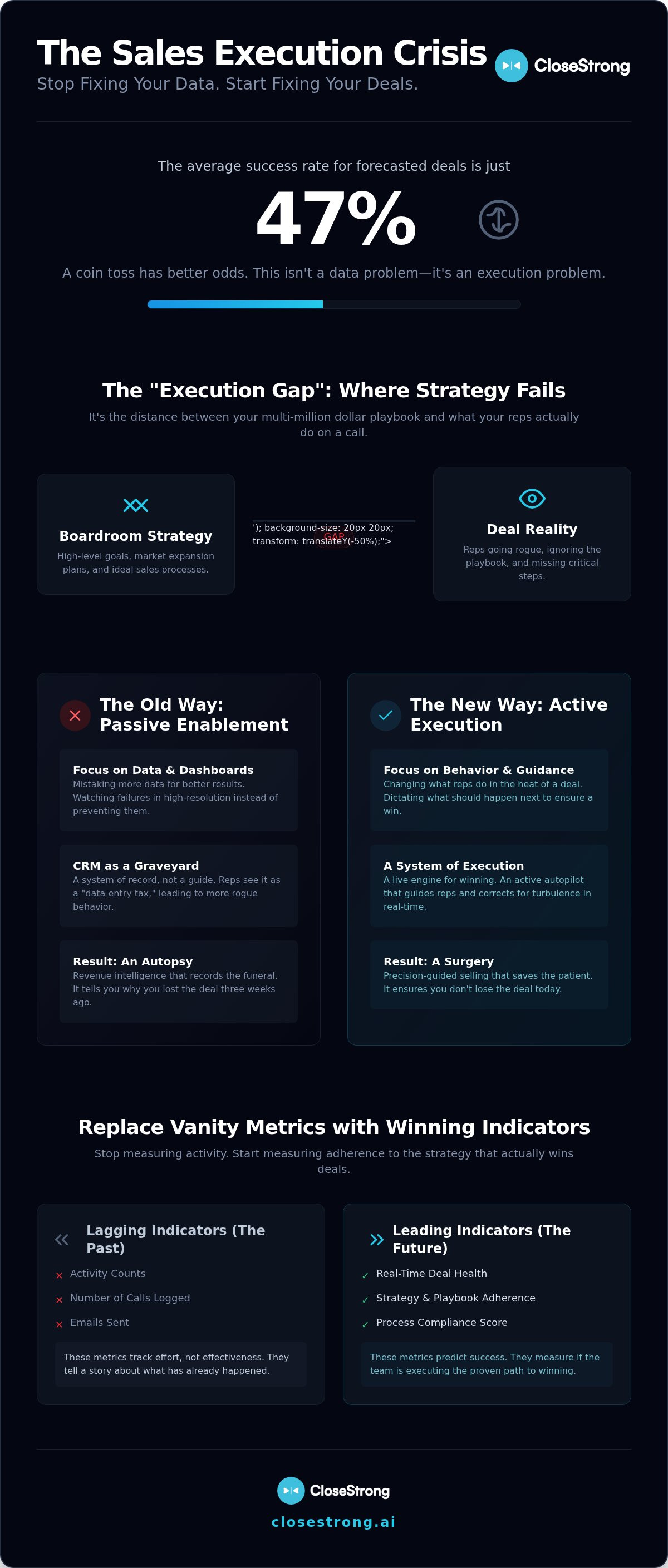
Stop counting calls. It is a vanity metric that makes managers feel busy while the pipeline rots. Fifty dials don't equal one good deal. They just mean your rep is good at hitting buttons. True enterprise sales process optimization requires a radical shift in what you track. Stop measuring "what they did" and start measuring "how well they executed." You don't need more activity. You need more precision.
Lagging indicators like win rates are autopsies. They tell you why you lost a deal you already buried. To win, you need to track "Adherence to Strategy." Are your reps actually following the playbook in the heat of the deal? This is the only leading indicator that matters. If they aren't executing the strategy, the outcome is just a coin toss. Verified data shows the success rate for forecasted deals is only 47 percent. That is effectively a flip of a coin. You can't build a predictable revenue engine on those odds.
Real-time deal health is the cure for high forecast variance. Most leaders look at a "Health Score" and think they have visibility. They don't. A score without a diagnosis is just a number on a screen. You need to know exactly which milestone was missed and why. Deal Health is a quantifiable measure of how closely a rep's behavior aligns with your winning strategy. When you use diagnostic sales deal health software, you spot the slips before they become losses. You move from wondering if a deal will close to knowing it will.
Stop coaching to the goal. Everyone knows the goal is to close. Start coaching to the gap. Use execution data to identify the specific behavioral bottlenecks holding your reps back. Is it discovery? Is it stakeholder mapping? Is it building the business case? Every deal review should be a strategic execution session, not a status update. Reducing "unforced errors" like missing a key stakeholder or failing to align with a buyer's timeline is the fastest way to increase your bottom line. You don't need a new strategy. You need your team to actually execute the one you have. Stop guessing and start guiding your deals with the CloseStrong execution platform.
You have done the hard work of enterprise sales process optimization on paper. You have mapped the stages. You have enriched the data. You have even built the dashboards. Yet, your forecast variance remains high and your reps are still winging it on high-stakes calls. Why? Because you're still treating execution as an afterthought. CloseStrong isn't another layer of tracking; it is a layer of execution. It is the bridge between your expensive corporate strategy and the messy reality of a live deal room.
In the 2026 market, the stakes are too high for "gut feelings." Buyers are more informed, committees are larger, and the number of interactions required to close an enterprise deal has risen to 27. You cannot coach your way out of that level of complexity with monthly reviews. You need complex B2B sales software that provides real-time intervention. CloseStrong turns the DNA of your top 5 percent into a repeatable system for the entire team. It doesn't just record the outcome; it dictates the next move.
Generic playbooks fail in the enterprise space because they lack context. A one-size-fits-all PDF can't tell a rep how to handle a specific objection from a CFO in a mid-cycle negotiation. CloseStrong provides custom deal guidance that adapts to the specific nuances of every opportunity. It is the difference between a static map and a live GPS. By injecting your winning methodology directly into the rep's workflow, you scale excellence without adding headcount. You stop hoping for a "hero" to save the quarter and start building a machine that produces them—a process often enhanced by the synthetic workforce and AI agent strategies developed by Navo Inc..
Guidance that changes based on buyer behavior, not just CRM stage.
Ensuring every rep follows the "Critical Path" for enterprise closing.
Codifying the instincts of your best sellers so B-players can execute like A-players.
Most "optimization" efforts are treated as projects with a start and end date. True execution is a platform. It is a fundamental shift in how you manage your revenue engine. The transition from "Enablement" to "Execution" is the only way to secure predictable growth in a volatile market. It's time to stop fixing your data and start fixing your deals. The technology exists to close the gap between what you want your reps to do and what they actually deliver. Stop guessing and start guiding with CloseStrong.
The time for passive reporting is over. You've spent years refining your stages and cleaning your data, yet the execution gap remains as wide as ever. Real enterprise sales process optimization isn't found in a prettier dashboard or a longer training session. It lives in the moment of action. It's the difference between knowing why you lost and ensuring that you win. By shifting from passive enablement to active, real-time guidance, you move beyond the coin-toss forecast and start building a predictable revenue machine.
You can continue to play the autopsy game with your CRM, or you can finally bridge the gap between your strategy and your reps' reality. Use Precision Guided Selling™ technology to eliminate forecast variance and close the strategy-execution gap for good. It's time to stop hoping for results and start engineering them. Execute your strategy on every deal with CloseStrong. Your pipeline is waiting for a leader who knows how the mechanics of the win actually work. Be that leader.
Enablement is about providing resources, while optimization is about enforcing behavior. Enablement gives your reps a library of "what" to use, but enterprise sales process optimization ensures the "how" actually happens in the deal room. One is a passive collection of tools; the other is the active engine that dictates how those tools are applied to win complex deals.
Most projects fail because they mistake a CRM mapping exercise for a behavioral shift. Leaders spend months refining sales stages but zero time ensuring reps actually execute the strategy inside those stages. If your optimization effort doesn't change what a rep says on a discovery call, it isn't optimization. It's just administrative overhead that your team will eventually ignore.
Precision Guided Selling™ improves accuracy by replacing rep opinions with verified buyer actions. Instead of asking a rep how they "feel" about a deal, the platform tracks specific milestones and strategy adherence in real-time. This removes the optimistic bias that leads to the typical 47 percent success rate for forecasted deals. When your data is based on execution rather than gut feelings, forecast variance disappears.
Yes, you can and should optimize without a CRM overhaul. Your CRM is a system of record; it's a graveyard for data. True optimization requires a system of execution that sits on top of your existing tech stack. You don't need a new database to hold your notes. You need a layer of real-time deal guidance that forces your winning strategy into the rep's natural workflow.
The most critical KPIs are strategy adherence and milestone velocity. Stop obsessing over vanity metrics like call volume or email counts. Focus on leading indicators that signal real deal health, such as whether a rep has aligned with the prospect's internal timeline or mapped the full buying committee. These metrics tell you if a deal is actually healthy or just taking up space in your pipeline.
You get senior reps on board by reducing their cognitive load, not by adding more reporting requirements. Top performers hate "process" that feels like busywork. Show them that standardized execution makes the right move the easiest move. When the system handles the administrative rigor and provides high-quality deal guidance, they can spend more time selling and less time guessing.
No, revenue intelligence is a passive autopsy while sales execution optimization is an active intervention. Revenue intelligence tells you why you lost three weeks after the deal is dead. Execution optimization provides the guidance needed to win the deal today. One records the failure; the other prevents it by embedding your methodology into the live deal room.
You will see visibility results immediately and revenue impact within one full deal cycle. Within days, you'll identify the specific gaps where your strategy is failing. As your team adopts real-time guidance, the reduction in unforced errors leads to higher win rates. True optimization pays for itself by saving the high-stakes deals that used to slip through the cracks due to poor execution.


