





Why is your six-figure sales methodology currently gathering digital dust in a SharePoint folder while your reps "wing it" on every discovery call? It is a brutal reality for most leaders. You spend months building a strategy, yet 53% of your forecasts still fail because of inconsistent, rogue behav...
Why is your six-figure sales methodology currently gathering digital dust in a SharePoint folder while your reps "wing it" on every discovery call? It is a brutal reality for most leaders. You spend months building a strategy, yet 53% of your forecasts still fail because of inconsistent, rogue behavior. You don't have a motivation problem. You have an execution friction problem. If you want to drive sales playbook adoption, you have to stop treating your process like a static textbook and start treating it like a GPS.
We both know the rogue rep routine. It creates high forecast variance and guts your ROI on expensive training. You are likely tired of playing process police and chasing compliance that never sticks. This guide changes that. You will learn a 4-step framework to turn your playbook into a deal-closing engine that reps actually want to use. We are stripping away the corporate fluff to show you how Precision Guided Selling™ creates predictable revenue growth and higher win rates across your entire team without the constant policing.
• Identify the "Execution Gap" that causes 90% of sales playbooks to be abandoned within 30 days of launch.
• Learn how to drive sales playbook adoption by reducing friction; reps are biologically wired to follow the path of least resistance.
• Master a 4-step framework to audit your process for wasted steps and deliver contextual guidance exactly when a deal needs it.
• Shift your focus from vanity metrics like "logins" and "page views" to real-world adherence that moves the needle on win rates.
• Discover how Precision Guided Selling™ turns your strategy into an invisible deal-closing engine that reps actually use.
Your sales playbook is likely a 50-page PDF that cost six figures to develop and currently has the engagement level of a terms-and-conditions page. It is not just a minor oversight. It is a systemic failure. Research indicates that 90% of sales playbooks are forgotten within 30 days of their launch. This happens because most playbooks are an interruption to the workflow, not an integration of it. You expect reps to pause a high-stakes negotiation to go hunting for a "discovery guide" in a separate portal. They won't do it. They shouldn't have to. In the same way that sales productivity relies on centralizing tools, personal productivity also benefits from a single source of truth; to see how a central hub can help you organize your most important life documents, you can explore SafeKeep Premium.
This friction creates the Execution Gap. It is the canyon between your high-level corporate strategy and the messy reality of a live sales call. You have a strategy; your reps have a conversation. When those two things do not align, you lose. To drive sales playbook adoption, you must stop building libraries and start building GPS systems. An "invisible" playbook doesn't ask for attention. It provides guidance exactly where the work happens. It removes the need for reps to choose between following the process and closing the deal.
Enablement often treats sales like a school subject. It focuses on knowledge. Execution, however, focuses on action. You don't need a rep who can pass a quiz on MEDDICC; you need a rep who actually qualifies the economic buyer during the call. Stop taxing your top performers with more training. They don't need more slides. They need less friction. The myth that better graphic design or a more "interactive" PDF will change behavior is exactly that: a myth. Reps don't care how pretty the playbook is if it gets in the way of their commission check.
When your team goes rogue, your forecast becomes a work of fiction. This is not about process compliance for the sake of checking a box. It is about predictable revenue. Relying on a "Hero Culture" where three star reps carry the entire quota is not a business model. It is a liability. It prevents you from scaling because the "magic" stays in the heads of a few people. This is the core of the scale sales strategy execution crisis in enterprise firms today. Without a way to standardize behavior across the middle-of-the-pack, your growth is capped by the limitations of your best people rather than the strength of your system. To drive sales playbook adoption effectively, you have to make the right way the easiest way.
Stop blaming your reps for being "unmotivated." They are actually highly motivated to do one thing: close deals with the least amount of effort possible. This is the "Path of Least Resistance" rule. It is a biological imperative, not a personality flaw. Humans are hardwired to conserve energy. If your process adds friction, they will bypass it. Every time. To drive sales playbook adoption, you must stop trying to change human nature and start changing the environment where the work happens.
There is a fundamental difference between compliance and adherence. Compliance is doing something because a manager is watching. It is fragile; it is expensive; it requires constant policing. Adherence is doing something because it actually helps win the deal. You don't want a team that follows the playbook because they are afraid of a performance review. You want a team that follows it because they are afraid of losing a commission check. Shift your mindset from being a "Playbook Policeman" to a "Strategic Guide" who provides the tools for victory. For those leading mid-sized companies who want to master this transformational shift, check out Inspired Leadership.
Every click is a tax. The "Alt-Tab" tax, where reps move between the CRM, their email, and a static PDF, kills momentum. Complexity is the enemy of execution. When a rep is handling a high-stakes objection, their cognitive load is already peaked. They cannot remember page 24 of your methodology while trying to save a million-dollar deal. If the guidance isn't right there, in the flow, it doesn't exist. You have to remove the mental gymnastics required to stay on track.
Most leaders try to solve adoption with "motivation." They offer rewards, gift cards, or gamification. This is a losing battle. Top reps don't need more motivation to sell; they need fewer distractions from the sale. The only question that matters to a rep is "What's in it for me right now?" If your playbook doesn't provide immediate, deal-level value, it will be ignored. You can stop playing process police and start seeing real results by engineering the friction out of your sales process. Stop asking for adoption. Start providing an unfair advantage that makes winning inevitable.
Stop trying to "motivate" your team with pep talks and gift cards. Motivation is a feeling; execution is a system. If you want to drive sales playbook adoption, you need to stop acting like a cheerleader and start acting like an engineer. You don't need reps who are "inspired" to follow the process. You need a process that is so streamlined it becomes the path of least resistance. This 4-step framework moves your playbook from a theoretical document to a tactical edge.
First, audit for friction. Be ruthless. Look at every stage of your sales cycle and ask: "Does this specific activity directly lead to a closed-won outcome?" If the answer is "maybe" or "it is good for reporting," delete it. You must strip your playbook down to precision actions. Most leaders fail here because they value "completeness" over "clarity." Your reps don't need a map of the entire world; they need a flashlight for the next ten feet.
Apply the "One Stage, One Action" rule. In complex B2B sales, cognitive overload is a deal killer. Instead of giving a rep ten things to remember, give them the one play that matters for the specific stage they are in. Generic advice is the primary reason why complex B2B sales software often turns into an expensive filing cabinet. If the guidance isn't contextual to the deal, it is just noise. Drive sales playbook adoption by making the guidance so relevant that ignoring it feels like a tactical error.
Third, automate the adherence. Stop checking their work after the deal is lost. Post-mortem reviews are just autopsies; they tell you why the deal died, but they don't bring it back to life. You need "in-flight" guidance. This is where an enterprise sales execution platform becomes mandatory. It embeds your strategy into the workflow so that adherence isn't a separate task. It is just how the work gets done.
Finally, close the feedback loop. A playbook should be a living organism, not a fossil. Use your deal outcomes to refine your plays in real-time. If a specific objection-handler is failing in the field, change it globally by Friday. When reps see that the playbook evolves based on their reality, they stop viewing it as corporate mandate and start viewing it as a competitive advantage. You don't scale by sticking to a plan that is six months old. You scale by engineering a system that learns as fast as your market moves.
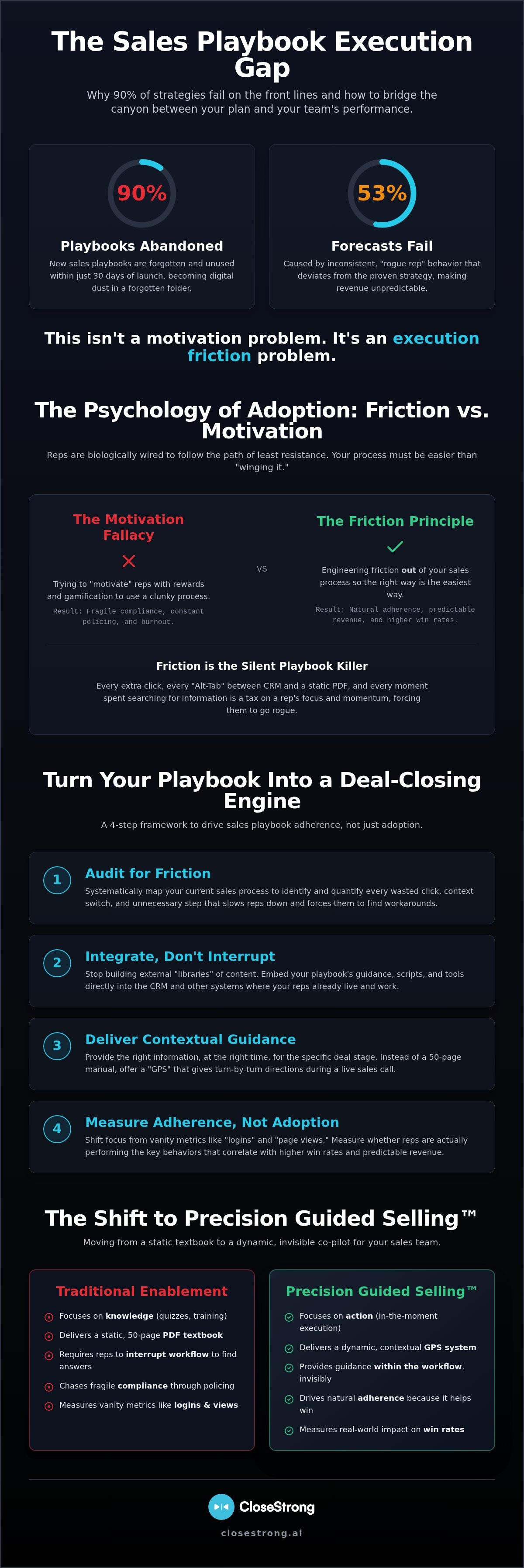
Your enablement team is likely celebrating "100% completion" on a new training module while your win rates remain stagnant. This is the Knowledge Trap. Knowing the playbook is not the same as executing it when a prospect is tearing your pricing apart. If you want to drive sales playbook adoption, you have to stop measuring what reps know and start measuring what they do. Logins, page views, and quiz scores are vanity metrics. They tell you someone looked at the map. They don't tell you if they are actually driving the car toward the destination.
The only metric that matters is the correlation between playbook steps and win rates. Are deals that follow Step 3 closing 20% faster? That is data. Are reps who use the "Economic Buyer" play seeing higher contract values? That is reality. Everything else is just digital noise. To truly drive sales playbook adoption, you must pivot from tracking activity to tracking outcomes. Adherence is not a checkbox. It is a revenue driver.
More content does not lead to more revenue. It leads to diminishing returns and rep paralysis. Most companies have "Content Repositories" where playbooks go to die. You need an "Execution System." Contrast the two: Enablement is about teaching a methodology in a classroom. Execution is about guiding a rep through a deal in real-time. One is a lecture; the other is a co-pilot. If your strategy relies on a rep remembering a 50-page PDF during a heated negotiation, you have already lost. Stop teaching them to pass tests. Start guiding them to win deals.
Stop looking at usage stats and start looking at deal health. You can use sales deal health software to identify exactly where the process is breaking down. It isn't about whether they opened the playbook file. It is about whether they skipped a critical stage-gate that will ruin the forecast next month. Precision in sales execution ensures that every action taken is the shortest path to a signed contract. Identifying these violations "in-flight" allows you to fix the deal before it becomes a post-mortem statistic.
If you are ready to stop tracking page views and start tracking win rates, see how an execution platform enforces adherence to your winning strategy.
Stop hoping your team will suddenly develop a passion for process compliance. They won't. Hope is not a management strategy. It is a recipe for missed quotas and high forecast variance. If you want to drive sales playbook adoption, you have to stop asking for it and start engineering it. Precision Guided Selling™ is the shift from passive documentation to active execution. It is not a suggestion. It is the framework for how you win. It doesn't live in a separate browser tab; it lives where the deal lives.
CloseStrong embeds your corporate strategy directly into the individual deal workflow. We don't provide generic "Next Steps" that reps ignore. We provide custom, high-quality deal guidance based on the specific reality of the account. This is how you turn every rep into your "Best Rep." You are no longer limited by the innate talent of a few stars. You are scaling a proven system that works for everyone. To drive sales playbook adoption, you must make the right way the only way.
We eliminate the "Alt-Tab" tax. Your reps shouldn't have to hunt for the right play; they should be guided by it in real-time. Think of the difference between a paper map and a GPS. A map requires you to stop, study, and hope you don't miss a turn. A GPS tells you exactly when to pivot based on the road ahead. Most playbooks are static maps gathering dust. CloseStrong is the GPS for enterprise sales. This is why leaders choose execution over simple enablement. They are tired of teaching; they want results.
Scaling your strategy shouldn't mean doubling your management headcount just to police behavior. Automated guidance reduces the coaching burden on your managers. They can stop acting like process auditors and start acting like deal strategists. This creates a "Winning Habit" across the entire organization. To support your executives in navigating these organizational shifts, visit Simon Lead LLC for professional coaching. When execution is consistent and guided, rigor becomes the standard, not the exception. You aren't just launching a playbook; you are building an engine that produces predictable revenue growth.
The days of the "Dusty PDF" are over. It is time to bridge the Execution Gap and ensure your strategy actually reaches the field. See how CloseStrong drives playbook adoption on every deal.
Stop treating your sales strategy like an optional reading list. It isn't a suggestion; it is the blueprint for your revenue. We have established that the "Dusty PDF" is dead and that "more training" is a tax your top reps won't pay. To truly drive sales playbook adoption, you must bridge the Execution Gap by making the right way the easiest way. Adherence isn't about checking boxes on a quiz. It is about the direct correlation between your plays and your win rates.
You have the framework. You understand the psychology of friction. Now, you need the technology to scale it. CloseStrong's Enterprise Sales Execution Platform uses Precision Guided Selling™ technology to provide custom deal-level guidance where the work actually happens. You can stop playing process police and start seeing predictable growth across your entire team. The status quo is expensive, but the solution is precise.
Stop chasing reps and start guiding deals with CloseStrong. It is time to turn your playbook into a high-performance engine.
Look at your top performers. If they are winning by ignoring your process, your process is the problem. If everyone is following it and still losing, your strategy is flawed. But if win rates are inconsistent across the middle, you have an execution gap. It is rarely a "people" problem. It is almost always a friction problem that prevents reps from executing the plan.
Friction is the silent killer of adoption. Reps are biologically wired to take the path of least resistance. If your playbook requires them to "Alt-Tab" out of their workflow or read 50 pages of theory, they won't do it. They don't ignore it because they are lazy. They ignore it because it gets in the way of their commission check. Make the right way the easiest way.
Manual adoption is a myth at enterprise scale. You can strip your playbook down to a one-page cheat sheet to reduce cognitive load, but you are still relying on human memory. Without technology to embed guidance into the deal flow, you are still playing process police. Manual methods don't scale. Systems do. You need an execution platform to bridge the gap between strategy and reality.
Update it based on deal outcomes, not the calendar. If a specific play isn't working in the field today, change it by Friday. Static playbooks are fossils. To drive sales playbook adoption, reps need to see that the guidance is a living system that reflects the current market reality. If they see the playbook evolving based on their wins and losses, they stop viewing it as a corporate mandate.
No. Gamification treats sales like a playground. It might drive short-term activity, but it doesn't drive long-term adherence. Reps don't need digital badges or leaderboards; they need to win deals. If the playbook helps them close a million-dollar contract, that is the only "game" they care about. Focus on providing deal-level value rather than superficial rewards that don't move the needle.
Methodology is the theory; the playbook is the tactical execution. MEDDICC or Challenger are methodologies that provide a framework for thinking. A playbook tells the rep exactly which questions to ask a specific buyer at a specific stage. Methodology is the map. The playbook is the turn-by-turn directions. One tells you what to think. The other tells you what to do to win.
You don't. You learn from them. Your star reps have already cracked the code. Instead of forcing them into a subpar process, use their successful behaviors to refine the playbook for everyone else. Once the playbook reflects the most effective way to win, even the stars will use it to save time. They value results, not compliance. Give them the tools to win faster.
CRM is a database, not a guidance system. Simply putting a link to a PDF inside a CRM field is just moving the "Dusty PDF" to a different folder. To truly drive sales playbook adoption, you need a system that provides in-flight guidance. Adherence requires an execution platform that guides the rep during the deal, rather than a record-keeper that tracks what happened after the deal was lost.


