





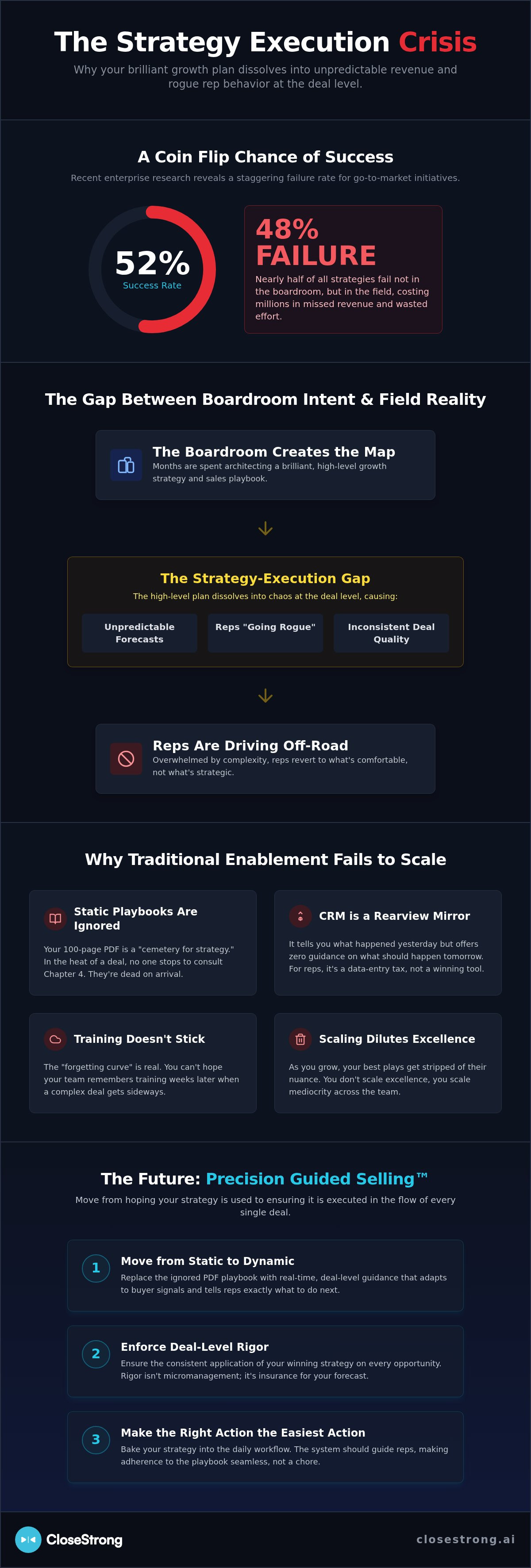
Only 52% of enterprise leaders managed to successfully execute their go-to-market initiatives last year. It's a staggering failure rate. You spent months architecting a brilliant 2026 growth plan, yet your reps are still "winging it" in the field. If you can't scale sales strategy execution at the i...
Only 52% of enterprise leaders managed to successfully execute their go-to-market initiatives last year. It's a staggering failure rate. You spent months architecting a brilliant 2026 growth plan, yet your reps are still "winging it" in the field. If you can't scale sales strategy execution at the individual deal level, your high-level vision is just expensive wallpaper. The boardroom creates the map, but the reps are driving off-road.
You've seen the symptoms. Unpredictable forecasts. Reps going rogue. Inconsistent deal quality that makes scaling feel like an impossible dream. It's frustrating because you know the strategy is sound, but the execution is broken. It's not a training problem. It's a guidance problem. This article bridges that catastrophic gap. You'll discover how to move past generic training and start driving predictable revenue through Precision Guided Selling™. We'll examine exactly why enterprise plans fail at the deal level and how to align your corporate goals with every single rep's daily activity to eliminate forecast variance for good.
• Stop blaming your strategy for missed targets. The real failure happens at the deal level where high-level plans dissolve into inconsistent "rogue" rep behavior.
• Preparation is not performance. Learn why traditional sales enablement fails to stick and how to bridge the "forgetting curve" with execution-focused guidance.
• Discover the four essential pillars required to scale sales strategy execution across a global force without diluting the quality of your most effective playbooks.
• Transition from static, ignored documents to Precision Guided Selling™ to ensure your corporate strategy is actually used in the flow of every deal.
Strategy is what you say. Execution is what your reps actually do. Most leaders confuse the two. They spend six months crafting a "perfect" 2026 strategy, drop it into a slide deck, and wonder why the forecast looks like a crime scene three months later. It's not a lack of talent. It's a failure to scale sales strategy execution where it actually matters: at the deal level. The boardroom creates the map, but the reps are the ones driving the car. If they aren't looking at the map, the destination doesn't matter.
Recent enterprise research shows that only 52% of organizations successfully executed their go-to-market initiatives in the past year. That's a coin flip. When you try to scale, you usually end up with dilution. Your best sales playbooks, the ones that won you your first fifty enterprise clients, get stripped of their nuance as they're passed down to a hundred new hires. You aren't scaling excellence. You're scaling mediocrity. The "Hope and Pray" management style is dead. You cannot hope your team remembers the training, and you cannot pray they apply the strategy when a deal gets sideways.
The gap is the distance between corporate intent and individual rep action. In a small team, you can manage this with a few weekly syncs. In an enterprise, complexity kills. Every new product line and every new buyer persona adds a layer of friction. When reps feel overwhelmed by complexity, they go rogue. They revert to what's comfortable, not what's strategic. This rogue behavior isn't just a nuisance; it's a direct drain on revenue. It creates a disconnect where the "official" process exists only in a PDF, while the "actual" process is whatever the rep feels like doing that Tuesday.
Your CRM is a rearview mirror. It tells you what happened yesterday, but it offers zero guidance on what should happen tomorrow. Many leaders believe that better reporting will lead to better behavior. It won't. You cannot manage behavior through a spreadsheet. A robust sales operations framework is essential for infrastructure, but it's not a substitute for real-time execution. To your reps, the CRM is a tax. It's a data entry chore they perform to keep management off their backs. It's not a tool for winning deals. If your strategy relies on reps looking at a dashboard to decide their next move, you've already lost. Strategy execution requires a windshield, not a historical record. It requires guidance in the flow of work, not a post-mortem after the deal is lost.
Scaling is not a volume game. It is a replication game. Most enterprise leaders think they can hire their way into growth by simply adding more heads to a broken process. They are wrong. If your strategy is not being executed at the deal level, you are just scaling chaos. To scale sales strategy execution in 2026, you must move away from the "broadcast" model of leadership. You cannot just announce a strategy and hope it sticks. You have to bake it into the very fabric of the deal.
While the process must come first, the quality of your talent pool ultimately determines the speed of your growth; for those looking to build a high-performance team, you can explore Sales Recruiting and Placement to find individuals who are vetted for their ability to execute complex strategies.
Execution is not an afterthought. It is the work. In high-stakes enterprise environments, the difference between a win and a "no decision" often comes down to the smallest tactical choices made by a rep in the heat of a meeting. If those choices don't align with your high-level strategy, your plan has failed before the first slide is even shown. You need a system that makes the right action the easiest action. Not a suggestion. Not a training reminder. A requirement.
Your 100-page PDF playbook is a cemetery for strategy. Nobody reads it. Nobody follows it. In the middle of a complex negotiation, no rep is going to pause to consult "Chapter 4: Handling Objections." Static playbooks assume the world is predictable. It isn't. Execution in 2026 requires real-time, deal-level guidance that adapts to the specific signals of the buyer. This is why traditional CRM setups fall short. They record history; they do not guide it. For those managing multi-layered enterprise cycles, relying on complex B2B sales software that provides live feedback is the only way to ensure the strategy survives the first call.
Rigor is not micromanagement. It is insurance. It is the consistent application of your winning strategy on every single deal, regardless of which rep is carrying the bag. Most organizations manage by "gut feel" until the end of the quarter. By then, it's too late to fix the execution. You need to measure execution while the deal is still alive. Are the right stakeholders involved? Is the value proposition aligned with the specific business pain? True means having the data to prove execution is happening before the deal slips.
Standardizing the "how" does not mean turning your reps into robots. It means giving them a high-performance chassis so they can drive faster. When you provide Precision Guided Selling™, you aren't stifling creativity; you are removing the guesswork. You are giving them the guardrails they need to focus on the human side of the sale while the system ensures the strategic requirements are met. This is how you maintain high standards at scale without burning out your best talent.
Enablement is the gym. Execution is the championship game. Most enterprise leaders confuse the two. They think that because a rep passed a certification or sat through a three-day workshop, they are ready to scale sales strategy execution in the field. They aren't. Knowing the strategy and executing it under the crushing pressure of a multi-million dollar negotiation are two entirely different skill sets. Training is preparation. Execution is performance. If you are only focusing on the former, you are leaving the latter to chance.
The "Forgetting Curve" is a brutal reality in enterprise sales. It's a scientific fact that humans forget roughly 70% of new information within 24 hours if it isn't applied immediately. In a world of complex buyer committees and eighteen-month cycles, that strategy you taught in January is long gone by March. You cannot scale a business on "just-in-case" training. You need a system that provides guidance when the rep is actually doing the work. Not yesterday. Not tomorrow. Now.
Workshops don't scale. You can fly your global sales force to a resort, feed them steak, and show them four hundred slides. It won't change their behavior. Behavior is driven by the environment, not by a one-time event. Knowing what to do is only 10% of the battle. The other 90% is having the discipline to do it when the deal gets difficult. Traditional enablement focuses on "knowing," whereas true execution focus is about "doing"—a philosophy shared by Multifamily Schooled in their approach to teaching commercial real estate investment through practical, actionable frameworks. You don't need more training. You need better guidance in the flow of work. You need to move from preparation to performance.
Revenue intelligence was supposed to be the savior. It isn't. Recording a call and having an AI tell you that the rep didn't mention the value proposition is a post-mortem. It is an autopsy. By the time you review the transcript, the buyer has already moved on to your competitor. Conversation tracking is too late. Strategy execution happens before the call starts and while the deal is being shaped. Stop coaching the past. Start guiding the present. You don't need more intelligence about why you lost. You need an execution system that ensures you win. Intelligence tells you what happened; execution ensures what *should* happen actually does.
Strategy is not a document. It is a series of behaviors. To scale sales strategy execution, you must stop treating your plan like a suggestion and start treating it like a machine—much like how a modern agricultural operation depends on the specialized equipment and parts from webshop.strongmachinery.ro to maintain its productivity. You don't need more meetings; you need a framework that enforces discipline at the deal level. If your framework relies on human memory, it is destined to fail. If it relies on automated, real-time guidance, it is built to win. A scalable framework is built on four non-negotiable pillars.
Every deal must be forced through the lens of your corporate goals. If a deal doesn't match your strategic profile, the system should flag it immediately.
Reps shouldn't have to guess the next move. The system should provide live nudges based on the specific context of the deal.
You need a constant pulse on every deal. Not a monthly update. A real-time assessment of whether the deal is following the winning path.
Coaching must shift from "What happened?" to "How do we win this specific deal?" It's about changing the future, not critiquing the past.
The gap between your top performer and your newest hire is usually a gap in execution rigor. Your veterans have the "Winning Way" internalized. Your junior reps are still trying to find the office. You cannot wait three years for them to catch up. You must codify your best practices into a digital guidance system. This ensures that a junior rep executes with the same strategic precision as a ten-year veteran. It is not about taking away their personality; it's about giving them a high-performance engine. While many teams look for sales deal health software to track progress, true scaling happens when you guide the actions that create that health in the first place.
Forecast variance is the tax you pay for poor execution. When reps "wing it," your forecast becomes a work of fiction. Rigor is the only cure. By enforcing a consistent execution framework, you can spot gaps months before they become "deal slips." Deal reviews should no longer be interrogations where managers try to catch reps in a lie. They should be strategic sessions where both parties look at the execution data to find the path to "closed-won." When you have total alignment between strategy and activity, the variance disappears. The numbers become predictable because the behavior is predictable. If you are ready to stop guessing and start executing, see how our enterprise sales execution platform works.
The sales technology stack of the last decade was built for volume. We bought tools to send more emails, make more calls, and track more activity. It worked for a while. But in 2026, volume is a commodity. Your buyers are exhausted by "engagement" and "outreach." They don't want more touchpoints; they want more value. To scale sales strategy execution in this environment, you have to stop focusing on how much your reps are doing and start focusing on how well they are doing it. You need an execution platform, not just another engagement tool.
CloseStrong represents the missing layer in the enterprise stack. Your CRM is the system of record. Your Sales Engagement Platform is the system of activity. CloseStrong is the system of execution. It is the bridge between the CRO's vision and the individual deal. We move strategy out of the slide deck and directly into the rep's workflow. It is the end of the "strategy-to-execution" gap. It is the beginning of predictable, scaled performance.
Precision Guided Selling™ is not a generic chatbot or a static checklist. It is real-time, deal-specific guidance powered by your unique winning strategy. It doesn't tell a rep "what" to sell; it guides them on "how" to win. While generic tools offer basic templates, this approach provides tactical nudges based on live deal signals. When a new stakeholder enters a multi-million dollar deal, the system doesn't just record the name. It guides the rep on the specific value pillars that stakeholder needs to hear. This is the fundamental purpose of the enterprise sales execution platform. It ensures that your best strategic thinking is present in every room, even when you aren't.
Transitioning your team from guessing to executing creates a massive ROI. You see higher win rates, shorter sales cycles, and a total elimination of the "forecast fluff" that haunts most end-of-quarter reviews. Protecting this growth is essential for long-term success, and firms like 41legacy.com help business owners understand and defend their enterprise value.
Let's talk straight. Your strategy is only as good as the weakest rep's ability to execute it. If your plan doesn't survive the first call, it isn't a strategy. It's a hallucination. An expensive, boardroom-level hallucination. Precision Guided Selling™ turns that hallucination into reality. It gives your team the guardrails they need to perform at their peak and gives you the confidence that your plan is actually being followed. Stop hoping for execution. Start guiding it.
Your 2026 strategy is not a slide deck. It is the sum of every action your reps take in the field. Most enterprise plans fail because they never leave the boardroom. They stay trapped in PDFs while reps "wing it" during complex negotiations. To scale sales strategy execution, you must move past the myth of enablement and embrace the reality of execution. Training is just preparation. Performance requires real-time guidance.
The choice is binary. You can continue to hope your team remembers their training, or you can implement a framework that makes excellence the default. Precision Guided Selling™ technology provides the enterprise-grade deal guidance and no-nonsense sales rigor required to eliminate forecast variance. It is the difference between guessing why a deal slipped and knowing exactly how to win it. It is time to bridge the gap between your vision and your revenue.
Stop guessing and start guiding. See how CloseStrong scales your sales strategy.
The path to predictable enterprise growth is built on discipline, not luck. You have the strategy. Now, give your team the engine they need to reach the finish line.
Strategy is the "what" and "why" found in your boardroom slide deck. Execution is the "how" that actually happens in the trenches. Strategy is a map; execution is the driving. Most enterprise organizations have a brilliant map, but their drivers are lost in the woods because they don't have a GPS. Strategy is intent. Execution is action. To develop this mindset further, Studio Showdown offers a strategy guide focused on building entrepreneurial skills through screen-free competitive play.
Complexity is the primary killer of scale. As your organization grows, the nuance of a winning strategy gets diluted through layers of management. You aren't scaling excellence. You're scaling a game of "telephone" where the original message is lost by the time it reaches the frontline rep. Without a system to enforce consistency, reps revert to what's comfortable rather than what's strategic.
Stop looking at the final revenue number as your only metric. Revenue is a lagging indicator that tells you what happened three months ago. To measure execution, you must track "deal rigor" in real-time. Are reps involving the right stakeholders? Are they following the specific value pillars defined in your playbook? If you can't see the behavior, you aren't measuring execution.
Static playbooks and "just-in-case" training are the biggest hurdles. Reps don't have the bandwidth to memorize a 100-page PDF, and they forget 70% of training within 24 hours. When the pressure of a multi-million dollar deal hits, they revert to old habits. Without live, deal-level guidance, your strategy is just a suggestion that gets ignored when things get difficult.
Absolutely. A CRM is a filing cabinet for historical data. It's a rearview mirror that records what happened yesterday. Sales execution software is a windshield. It provides live, tactical guidance to help your team scale sales strategy execution while the deal is still active. One records history; the other shapes it. Don't confuse a database with a GPS.
To ensure that this "windshield" is showing the most accurate picture of the business landscape, many enterprises integrate Stratoryn to pull AI-powered business intelligence directly from their ERP data.
Stop trying to "motivate" them with speeches or town halls. Make the right action the easiest action. If following the strategy helps them close bigger deals with less friction, they'll do it. Motivation follows success, not the other way around. Give them the tools to win, and the compliance will take care of itself. Reps follow what works.
It is a framework that delivers custom, deal-specific guidance directly into the rep's flow of work. It isn't a generic checklist or a chatbot. It uses specific deal signals to nudge reps toward the most strategic move at that exact moment. It ensures every rep on your team performs with the same precision as your top 1% veteran.
RevOps is the architect of the execution engine. Their job isn't just managing the tech stack or cleaning data; it's about building the infrastructure that enforces your strategy. They provide the systems that allow you to scale sales strategy execution across the entire revenue engine. They bridge the gap between high-level corporate goals and the daily tools reps use to win.


