



Don’t fire a high-performing rep just for working differently, and don’t excuse behavior that damages deals or team trust. The practical answer to how to stop sales reps from going rogue is to make follow-up visible, set clear next steps, and judge individual behavior against shared standards. Keep...
Don’t fire a high-performing rep just for working differently, and don’t excuse behavior that damages deals or team trust. The practical answer to how to stop sales reps from going rogue is to make follow-up visible, set clear next steps, and judge individual behavior against shared standards. Keep the rep when their successful approach can be understood and shared; address it when independence comes at the expense of customers or colleagues.
It’s frustrating when one person seems to play by different rules, especially when strong results make the problem harder to confront. But the choice isn’t between tolerating chaos and forcing every rep into the same mold. Learn to spot risky behavior, improve visibility into deal follow-up, establish accountability without micromanaging, and guide reps through changes in expectations. The goal is a team that learns from standout performance without letting one person’s habits dictate how everyone sells.
• Separate high performance from harmful behavior by assessing whether a rep’s approach helps customers and can be understood by the wider team.
• Make follow-up visible by tracking the last interaction, the agreed next step, and who owns it.
• Spot renegade patterns such as bypassing shared processes or leaving opportunities without a clear next action, then address the behavior rather than the personality.
• Set a specific next step for every opportunity so reps and leaders can see what should happen next and when.
• Coach with clear reasoning, practical feedback, and room to adjust; turn effective individual habits into repeatable team practices.
Should you keep a high-performing rep who ignores the playbook? Look beyond the closed deals. In complex sales scenarios, lone wolves made up 25% of high-performing salespeople in the study described. That makes independence worth examining, not automatically rewarding or punishing. Find out which actions produce results, whether customers benefit, and whether colleagues can repeat the approach without copying harmful shortcuts.
A strong individual can still weaken the team. A rep might win by keeping deal information private, skipping agreed follow-up, or making promises others cannot deliver. Those wins may be real, but they leave colleagues without a repeatable approach and managers unable to forecast or coach consistently. Separate the result from the method: document what happened, identify which actions helped, and flag behavior that relies on secrecy or puts customers at risk.
Start with evidence, not office mythology. Ask the rep to walk through a recent win, from the first conversation to close. Identify how they qualified the opportunity, aligned stakeholders, handled objections, and agreed on next steps. Compare that sequence with other successful deals. If the approach works across different opportunities, it may improve the playbook. If it depends on private relationships or breaking rules, it is harder to scale.
Compensation and quotas should reward sound selling, not just bookings. Commission often makes up most of a rep’s compensation, and earnings rise with sales, so a plan focused only on volume can encourage risky shortcuts. Set quotas around the company’s strategy, then pair outcomes with clear expectations for customer fit, accurate deal updates, and agreed process. Don’t set targets that implicitly reward misleading claims or skipped follow-up.
Culture matters before any major change. Assess how the team currently sells and what employees think new expectations mean. A competitive team may welcome a shared method if it helps reps win; another may see it as control. Speak with experienced employees and trusted colleagues before changing the rules. Their feedback can reveal whether a process gap, product shift, or unclear quota is driving rogue behavior.
Resist the urge to launch a stack of initiatives after one bad quarter. Reps need time to understand a change, apply it, and keep selling. Paul Rosenberg describes rushed change as “ready, fire, aim” instead of “ready, aim, fire.” Use that contrast as a practical check: define the problem, get candid feedback, and choose a focused adjustment before rolling it out.
Then measure what changes. Track whether a rep’s successful actions can be shared, whether colleagues adopt them, and whether customers receive more consistent follow-up. When a complex, high-tech service changes the selling process, yesterday’s method may no longer fit. Update the playbook based on observed behavior, not assumptions. The goal isn’t identical performers; it’s a team where individual strengths improve shared execution without turning exceptions into the culture.
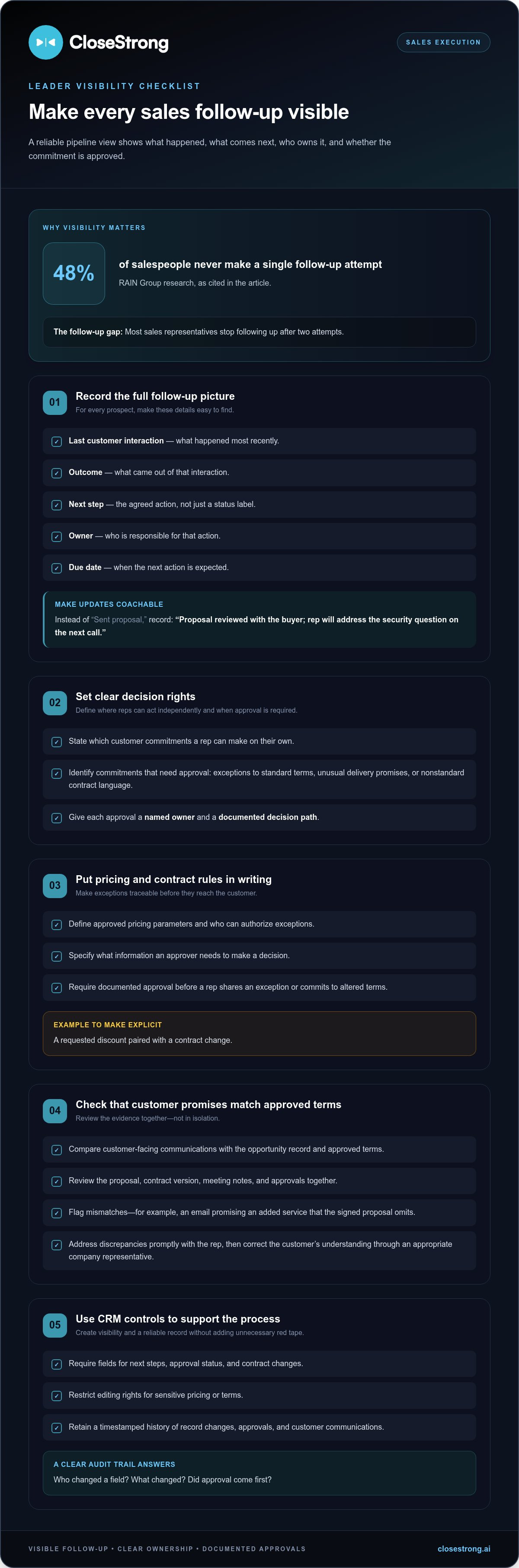
Follow-up disappears when leaders can’t see what happened after a call. Most sales representatives stop following up after two attempts. RAIN Group research reports that 48% of salespeople never make a single follow-up attempt. Those gaps make pipeline reviews unreliable and leave promising opportunities unattended. Leaders need a clear view of each interaction, commitment, and next action, not another status label.
Build visibility with a consistent opportunity record. For every prospect, capture the last customer interaction, its outcome, the next step, its owner, and its due date. “Sent proposal” isn’t a complete update. “Proposal reviewed with the buyer; rep will address the security question on the next call” gives leaders something they can coach and track.
Policies work when they define decision rights, not just broad expectations. State which customer commitments reps can make independently and which require approval, including exceptions to standard terms, unusual delivery promises, or nonstandard contract language. Give each approval a named owner and documented decision path. Clear limits help reps act quickly without mistaking personal judgment for company policy.
Put discounting, pricing, and contract rules in writing. Define approved pricing parameters, who can authorize exceptions, and what information an approver needs. Require documented approval before a rep shares an exception or commits to altered terms. Keep the rules aligned with the organization’s strategy, and explain them with practical examples, such as a requested discount paired with a contract change.
Managers can spot unauthorized discounts or promises by comparing customer-facing communications with opportunity records and approved terms. Review the proposal, contract version, meeting notes, and approvals together. Flag mismatches, such as an email promising an added service that the signed proposal omits. Address the discrepancy promptly with the rep, then correct the customer’s understanding through an appropriate company representative.
CRM controls can support this discipline without turning every deal into red tape. Use required fields for next steps, approval status, and contract changes. Restrict editing rights for sensitive pricing or terms, and retain a timestamped history of record changes, approvals, and customer communications. Managers can then trace who changed a field, what changed, and whether approval came first.
In the United States, rogue sales activity can expose an organization to disputes over pricing, contract terms, customer promises, or inaccurate sales claims. It can also raise compliance concerns when reps bypass company policies or make commitments outside their authority. Make sure reps understand approved claims and escalation paths, and preserve records showing what was offered, approved, and communicated.
To implement these controls, leaders should set the approval rules, configure required records, and review exceptions during pipeline meetings. Keep the process proportionate: routine customer updates shouldn’t need executive approval, but material pricing or contract changes should have a clear trail. An enterprise sales execution platform can help leaders put company strategy into action across deals, with guidance tied to the sales process.
Renegade behavior isn’t a personality type. It’s a pattern visible in decisions, customer interactions, and effects on the team. A rep who challenges a manager’s approach may offer useful insight. A rep who repeatedly hides decisions, misrepresents commitments, or blocks colleagues from engaging customers creates a different problem. Judge the conduct, not the confidence.
Watch for repeated exceptions that benefit one person while shifting risk to others. A rep might promise a delivery outcome without checking feasibility, leaving implementation colleagues to explain the gap. Another might keep a key customer contact private, preventing the team from maintaining continuity during an absence. These actions isolate knowledge and can weaken the customer relationship.
Some reps reject standard processes because their personal approach has worked before. That history can lead them to dismiss new guidance without testing whether it fits current buyers or offerings. Ask for a specific example: what changed, which customer response supports the decision, and what happened next? A reasoned challenge brings evidence forward. A blanket refusal protects habit instead.
Look for selective transparency, too. A rep may share good news with a manager but omit stalled decisions, unresolved objections, or strained customer relationships. In a deal review, compare the rep’s summary with customer emails, meeting outcomes, and commitments. The concern isn’t an imperfect forecast. It’s a repeated gap between what the rep reports and what customers actually experienced.
Another warning sign is behavior that makes colleagues depend on one person’s memory. If nobody else knows the buying group, customer concerns, or agreed path forward, the rep has made the opportunity fragile. Ask a colleague to explain the deal status using shared notes. If they can’t identify the buyer’s priorities or next decision, investigate the information gap.
The “10x salesperson” idea can obscure the difference between unusual talent and unhelpful conduct. The term echoes the “10x developer,” described as effective and efficient as 10 peers. But an exceptional seller’s individual output doesn’t prove their methods will work for others. A manager should separate repeatable selling skills from personal workarounds that teammates cannot safely copy.
Use a consistent review when a pattern raises concern. First, record the specific behavior and its effect on a customer or colleague. Next, ask the rep to explain the decision and what informed it. Then compare their explanation with deal evidence and team expectations. This grounds the conversation in facts, not a label or office rumor.
Talk with the rep directly and describe the observable impact. Ask what they would change next time, then agree on a behavior to review going forward. That approach preserves useful initiative while making repeated disruption harder to dismiss as simply “how top performers work.”
An opportunity without a next step is a guess dressed up as pipeline. Give every active deal a customer action, an owner, and a date. “Send proposal” names a task, but not the buyer’s decision process. “Buyer reviews proposal with finance, rep follows up Thursday” makes the commitment visible and testable.
Agree on the next step with the customer, not privately after the meeting. Before ending a call, confirm what each person will do and what decision follows. If a buyer needs to consult procurement, record that action and agree when to reconnect. A rep who chooses a follow-up date alone may create activity without moving the opportunity forward.
Use a consistent opportunity record to capture the customer’s goal, current concern, next action, responsible person, and timing. Note the source of each important detail, such as a buyer email, meeting note, or proposal comment. This gives another team member enough context to continue the conversation without relying on the original rep’s memory.
A useful next step connects to a decision, not just seller activity. “Call next week” is weak if nobody knows why the call matters. “Confirm whether the security team accepts the proposed review process” identifies the decision and its owner. This helps managers spot deals that appear busy but lack customer engagement.
Match the action to the opportunity’s stage and target. Early conversations may require confirming the business problem and identifying who else needs to weigh in. Later discussions may focus on resolving a contract concern or agreeing on implementation requirements. Don’t force every deal through an identical sequence. Set shared checkpoints, then tailor the next action to the buyer’s situation.
Review stalled opportunities by asking what changed, what evidence supports the current forecast, and what the customer has agreed to do next. If a rep can’t name a customer commitment, consider whether the deal needs a new discovery conversation rather than another generic follow-up. If the buyer’s priorities have shifted, update the plan instead of preserving an outdated target.
A sales platform can make these expectations part of daily execution with required next-action fields, reminders, and deal guidance. But fields alone won’t fix vague thinking. During reviews, managers should challenge entries like “circle back” and help reps define a useful customer outcome. A practical answer to how to stop sales reps from going rogue is to make the next move for every open opportunity clear and reviewable.
Leaders deciding how to stop sales reps from going rogue should give reps room to adapt their approach while keeping the customer’s agreed decision and ownership visible. That balance supports initiative without turning each deal into one person’s private project. When a rep changes course, the record should explain why and what the buyer agreed to do next.
Coaching works when it changes a specific behavior, not when it labels a rep difficult. Start with one observed moment, such as a prospect receiving a promise the delivery team couldn’t meet. Ask the rep what they intended, what the customer understood, and what they would do differently. That conversation helps distinguish a skill gap from low motivation or deliberate disregard for expectations.
Before changing a sales approach, assess each rep’s skills and motivations. Review available digital sales assessments alongside real examples, such as call notes or a stalled opportunity. A rep who struggles to ask discovery questions needs different coaching from someone who understands the process but refuses to use it. Don’t prescribe the same fix for different causes.
Explain why a new expectation matters. If reps must document customer commitments, connect the change to smoother handoffs and fewer conflicting promises. Then give them time to adjust and ask questions. Announcing a new rule without explaining its purpose invites workarounds. Clarifying the reason makes it easier to hear objections and distinguish practical barriers from resistance.
Make feedback concrete and forward-looking. Instead of saying, “You need to follow the process,” describe the moment: “You agreed to a delivery date before checking the team’s capacity.” Ask the rep to suggest a safer response for the next prospect conversation. Agree on what the manager will observe, such as confirming feasibility before making a commitment.
Use unfamiliar activities to interrupt entrenched habits. Improv theater can help reps practice listening and responding without relying on a memorized pitch. Even popping bubble wrap can break up routine before a team rehearses a new conversation sequence. The activity isn’t the fix. Coaching matters when reps connect the exercise to an actual customer interaction.
Track changes through observable behavior and customer responses. After introducing a new approach, review whether reps apply it in calls, how customers respond, and where questions remain. Ask employees what is getting in the way. Refine the approach when their actions or customer feedback show that the process needs adjustment.
For a rep who keeps going rogue, set one clear behavior to change and one review point. For example, require the rep to discuss proposed exceptions with their manager before presenting them to a buyer. Review the next relevant opportunity together, compare the customer communication with the agreed expectation, and recognize improvement. If the behavior continues, address the repeated breach directly instead of launching another team-wide initiative.
Build consistent deal guidance into daily execution with an enterprise sales execution platform that helps representatives apply company strategy across opportunities.
CloseStrong provides an Enterprise Sales Execution Platform that helps teams apply company strategy across deals. Its Precision Guided Selling™ technology guides reps through the closing process, while custom, high-quality deal guidance helps them act with clearer direction on each opportunity.
Turn to CloseStrong when shared expectations exist but execution still varies from deal to deal. The CloseStrong Enterprise Sales Execution Platform connects company strategy with what representatives do during the sales process, helping teams guide deal execution without mistaking visibility for tighter control.
If you’re ready to align deal execution with your strategy, contact CloseStrong or visit closestrong.ai.
Lasting change comes from making good selling behavior part of how the team operates, not from policing every rep. A practical answer to how to stop sales reps from going rogue is to turn clear expectations into consistent execution, then refine them as customers and opportunities change.
That shift takes more than a rulebook. Reps need useful direction when decisions are made, and leaders need a way to connect strategy with action across deals. CloseStrong’s Enterprise Sales Execution Platform, Precision Guided Selling™, and custom, high-quality deal guidance are built to support that work.
If your team is ready to bring stronger execution and deal guidance into its sales process, contact CloseStrong to strengthen your sales team. Start with the execution challenge you want to address, and take the next step toward a team that can sell with initiative and shared direction.
Keep a high performer if the concerning behavior can change and their expertise can benefit the team. First, distinguish blunt disagreement from conduct that harms customers or colleagues. A rep who challenges a qualification rule with evidence may improve the approach; one who knowingly misleads a buyer needs direct intervention. Set a clear behavioral expectation, then assess whether the rep follows it consistently.
A sales rep goes rogue when they repeatedly act outside agreed company expectations in ways that create risk or undermine coordinated selling. Examples include changing opportunity stages to make a forecast look stronger, using unapproved sales claims, or withholding relevant customer information from colleagues. A one-off mistake differs from a pattern. Look at the action, its effect, and whether the rep corrects it after feedback.
Rogue behavior can stem from conflicting incentives, unclear decision rights, or a sales process that no longer fits the product or buyer. Pressure to hit targets can make shortcuts seem rewarding, while frequent changes can leave reps unsure which expectations still apply. For instance, a new offering may call for different discovery questions, but reps may keep using an outdated pitch. Find the cause before prescribing a fix.
Use real selling situations to show how a policy applies, rather than asking reps to memorize rules in isolation. Have a manager and rep practice responding when a prospect requests an unsupported claim or an exception to standard terms. Ask the rep to explain their choices, give specific feedback, and repeat the scenario with a better response. This builds judgment for conversations that don’t follow a script.
Address the behavior promptly and base the conversation on evidence. Preserve relevant deal records, customer communications, and approval history, then give the rep a chance to explain what happened. Clarify the expectation and required correction, such as withdrawing an inaccurate statement through an appropriate company representative. Record the agreed follow-up and apply the organization’s established response consistently, especially if similar conduct has happened before.
Give reps freedom to handle routine customer questions while defining which decisions need approval. For example, a rep might schedule a follow-up or share approved product information independently, but escalate a request that changes contract terms. Make the escalation route clear and easy to use. Oversight can then protect important decisions without making customers wait for a manager to approve every ordinary response.


