


A deal strategy isn’t a discount plan. It’s a tailored approach to winning a specific opportunity by connecting the buyer’s priorities to business value and clear next steps. An executive buyer deal strategy identifies who controls the investment, which outcomes matter, and what terms can be traded...
A deal strategy isn’t a discount plan. It’s a tailored approach to winning a specific opportunity by connecting the buyer’s priorities to business value and clear next steps. An executive buyer deal strategy identifies who controls the investment, which outcomes matter, and what terms can be traded without giving away value. It also adapts as new information changes the deal.
It’s easy to mistake activity for progress: more calls, more stakeholders, more concessions. But a deal advances when the right people agree on the problem, the value, and the path forward. This guide explains how to identify the economic buyer, package negotiable terms into thoughtful trades, and adjust your approach as the facts shift. It also compares TAS, MEDDIC, and custom methodologies, so you can choose a practical structure for the opportunity instead of forcing every deal through the same script.
• Map the buying group to uncover who controls the budget, who evaluates the solution, and who can build internal support.
• Bundle negotiable terms and connect each concession to a clear return of value instead of discounting by default.
• Revisit your deal plan when new information changes the buyer’s priorities, stakeholders, or path to approval.
• Use TAS, MEDDIC, or a custom methodology to bring structure to the opportunity without forcing every deal into the same mold.
An economic buyer has final authority over budget, investment, and vendor agreements. That person may not lead the first call. Typical B2B buying groups include 6-10 people, with executives often engaging at critical decision points. Identify the leaders who set financial and budgetary goals, as the US EPA recommends. Then map each stakeholder by influence, role, and position on the business problem.
To identify and engage executive buyers, trace who owns the budget and which business outcome justifies the investment. Review annual reports, press releases, and LinkedIn profiles for stated priorities. Ask your champion who approves funding, who can veto the purchase, and which teams will feel its impact. Request an early meeting to align expectations and surface roadblocks. The economic buyer needs a concise case tied to organizational priorities, not a feature tour.
Map the committee before the pipeline advances. Record the economic buyer, technical evaluator, champion, and affected departments, then note each person’s concerns and decision role. Early involvement of decision-makers boosts win rates by 55%. Engaging the economic buyer, technical evaluator, and champion by Stage 2 can complete alignment that might otherwise take 3-4 weeks at Stage 4. Track executive engagement alongside stage movement, next steps, and unresolved approvals. A stalled stage with no executive access signals a gap, not momentum.
Common risks include relying on one contact, mistaking a champion for the budget owner, and escalating without context. These mistakes can leave approval requirements and objections hidden until late in negotiations. Engage the full committee, including at least five contacts directly affected by the problem. When a deal stalls, prepare an executive-to-executive conversation focused on strategic priorities and the decision needed. As leadership speaker and global executive David James Rhodes emphasizes, engaging at the senior leadership level requires aligning on authentic organizational purpose and shared direction rather than tactical pitches. First brief your executive on stakeholder positions, business impact, open issues, and walk-away thresholds. That preparation makes escalation purposeful, not a last-minute rescue.
Discounting first teaches buyers to focus on price rather than outcomes. Instead, prepare terms you can exchange, such as implementation timing, scope, payment structure, contract length, or executive access. Decide which terms matter most to your organization and where you can be flexible. Before negotiations begin, define your target, your minimum acceptable outcome, and what you need in return for each concession. This keeps negotiations moving without giving away value for free.
Make every trade explicit. If a buyer requests a shorter timeline, tie it to a clear commitment, such as a faster approval process or access to required teams. If they seek expanded scope, discuss a corresponding change in terms. When a buyer requests a concession, ask what they can contribute in return. Conditional trades protect the deal’s economics and make both sides accountable for progress.
Build the value case around the buyer’s own priorities, not a generic feature list. For example, an industry case might show an 18% reduction in operational costs and a 35% improvement in compliance efficiency. Present those as relevant evidence, then test whether the same outcomes matter to this organization. Quantify the business case with agreed measures, such as cost reduction, time-to-market, or customer lifetime value. Peer examples cite a 40% faster time-to-market or a 25% increase in customer lifetime value. Explain the assumptions and connect each measure to the buyer’s goals.
For executive discussions, lead with profit, growth, market share, or strategic advantage. Then show how the proposed terms support those outcomes. Avoid treating every negotiation as a price fight; a tailored value proposition can also create a path to future expansion. Keep the offer clear: what changes, what the buyer gains, and what commitment moves the agreement forward. Teams that need a consistent structure for these choices can use custom deal guidance to shape value-led conversations.
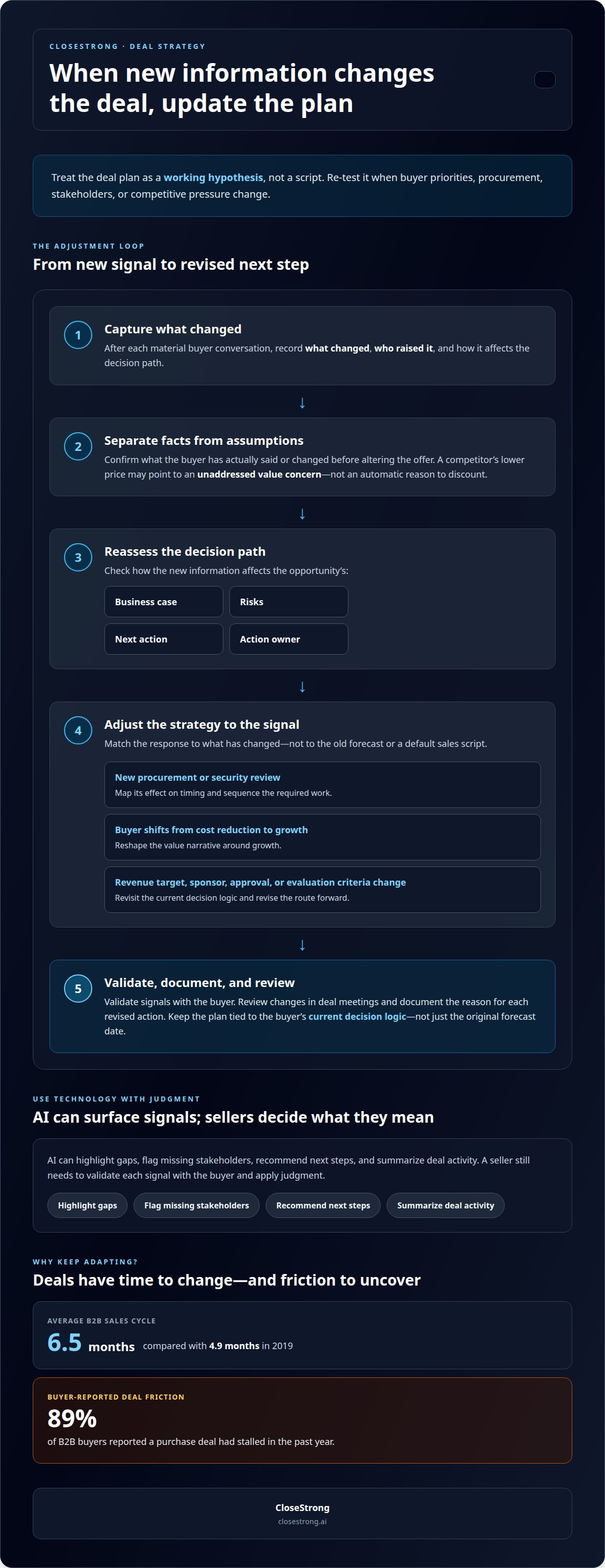
A deal plan isn’t a script. It’s a working hypothesis that must change when new facts alter buyer priorities, procurement cycles, or competitive pressure. The average B2B sales cycle is 6.5 months, compared with 4.9 months in 2019. In that time, budgets shift, internal sponsors change, and revenue goals evolve. Treat each new detail as a reason to test the plan, not defend yesterday’s assumptions.
Review every material buyer conversation. Record what changed, who raised it, and how it affects the decision path. Then update the opportunity’s business case, risks, next action, and owner. For example, a new procurement requirement may affect timing without changing the buyer’s desired outcome. A competitor’s lower price may reveal an unaddressed value concern, not automatically justify a discount. Separate facts from assumptions before changing the offer.
Watch for signals that call for a strategic adjustment: a revised revenue target, delayed approval, new executive sponsor, or changed evaluation criteria. If procurement adds a security review, map its impact on the decision and sequence the work. If the buyer prioritizes growth over cost reduction, reshape the value narrative around growth. Don’t keep advancing the same milestones when the buyer’s process has changed. An executive buyer deal strategy should track current decision logic, not just the original forecast date.
Use technology as an aid, not an autopilot. AI can highlight gaps, flag missing stakeholders, recommend next steps, and summarize deal activity. A seller still needs to validate each signal with the buyer and apply judgment. Review changes consistently at deal meetings, then document the reason for each revised action. That discipline matters: 89% of B2B buyers reported a purchase deal had stalled in the past year. A responsive methodology helps teams spot friction early and adjust the route before a stalled enterprise opportunity drains more cycles.
TAS, MEDDIC, and custom methodologies provide structure, but none should replace judgment. Use a framework to uncover decision gaps, assign next actions, and test buyer priorities. TAS can organize a target-account approach; MEDDIC can bring discipline to qualification and deal inspection. Choose the method that fits the opportunity’s complexity, buying process, and desired outcomes. Tailor its checkpoints to your sales process, rather than forcing every deal into identical steps.
What are the key steps in building an executive buyer deal strategy? Start by validating a prioritized business problem, then define the outcomes the buyer needs. Map the decision path, establish evidence for value, and assign clear owners to each open question. Set milestones around buyer actions, not seller activity. Before negotiation, align the sales team on objectives, roles, and walk-away thresholds. Review these checkpoints throughout the sales cycle and change course when the evidence shifts.
During discovery, ask executive buyers: “Which business priority makes this decision urgent?” “What outcome would justify the investment?” “How will you measure success?” Then clarify who approves funding, what could block approval, and how procurement fits the timeline. These questions reveal whether the opportunity addresses a real, prioritized problem or merely attracts interest. A useful methodology turns each answer into evidence, an owner, and a next step, not another unchecked CRM field.
Keep the framework practical. For a large deal, set explicit expectations for a champion, coaches, and affected contacts; the research recommends at least one champion, three or more coaches, and five or more contacts. Use those roles to test assumptions across departments, not inflate activity counts. Formal sales methodologies are associated with closing 11% more deals. That result depends on execution, not the acronym. Apply the method consistently, inspect gaps, and coach the team through the deal itself. Put a repeatable deal methodology into action by turning strategy into clear guidance for each opportunity.
CloseStrong helps enterprise sales teams put company strategy into action across individual deals. Its Enterprise Sales Execution Platform uses proprietary Precision Guided Selling™ technology to guide representatives through the closing process. For teams managing complex opportunities, its real-time guidance connects deal execution to company strategy. The platform captures deal-desk rules, competitive positioning, and customer decision drivers, helping reps apply that strategy throughout the deal.
Turn to CloseStrong when your sales team needs custom, high-quality deal guidance across complex opportunities. Precision Guided Selling™ provides real-time, in-context guidance for every rep, deal, and stage, supporting qualification, stakeholder alignment, and decision-criteria mapping. It helps reps adapt to buyer realities and execute your company’s strategy in the deal, rather than relying on a document or traditional training.
If you’re ready to explore how this approach could fit your sales execution, contact CloseStrong or visit closestrong.ai.
A strong executive buyer deal strategy should become a repeatable decision habit, not a document opened only when negotiations tighten. At your next pipeline review, choose one live opportunity and ask the team to identify its most consequential assumption. What evidence would confirm it? What buyer action would change the plan? Assign an owner to resolve the question, then record the decision and its effect on the next move. This creates a practical feedback loop without adding another layer of process. It also makes strategy visible in daily selling, where it can shape real choices.
The goal isn’t to control every variable. It’s to spot the moment your plan no longer fits and respond with intent. If you want to discuss how CloseStrong can support your deal strategy, talk deal strategy with CloseStrong. Take the next opportunity as a chance to make sharper decisions and move forward with confidence.
Deal strategy is the opportunity-specific plan for helping a buyer reach a purchase decision that supports both sides’ goals. It guides what the sales team learns, whom it engages, how it presents value, and which actions move the decision forward. For example, if a buyer needs internal approval, the plan might prioritize a concise business case over another product demonstration.
The economic buyer is the person who can authorize the investment and accept its financial implications. A department leader may champion a solution without controlling the budget. To distinguish the roles, ask who owns the relevant funds, who approves the business case, and who signs off on the commitment. Then compare those answers with the buyer’s actual decision process.
Executive buy-in connects a purchase to the organization’s priorities and gives the decision internal authority. Without it, a project can remain a team preference rather than a funded business priority. For example, an operations group may value faster workflows, while leadership needs evidence that the change supports broader goals. Executive alignment helps bridge that gap and clarify the decision’s urgency.
An executive buyer deal strategy is a tailored plan for aligning senior decision-makers around the business case, decision path, and terms of a specific opportunity. Unlike a generic sales playbook, it reflects the buyer’s priorities and approval dynamics. Use it to plan executive conversations, test assumptions, and choose the next action that advances a real business decision.
Start with the people already involved, then ask each contact who shapes the decision, approves funding, evaluates risk, or will use the solution. Build a simple map of each person’s role, influence, concerns, and connection to final approval. For instance, a finance leader may assess the investment while an operations lead defines practical requirements. Update the map as discussions reveal new participants.
Focus on outcomes tied to the executive’s current priorities, such as growth, profitability, efficiency, risk reduction, or customer retention. Executive consulting studios like michelboutinstudio routinely emphasize tying any proposed initiative directly to these core metrics. Establish the buyer’s baseline, desired change, and measurement method before presenting an ROI case. For example, if the priority is faster delivery, connect the proposed change to cycle time and its business impact, not simply to a feature list.


