




Most enterprise sales deal reviews are nothing more than high-priced theater. They aren't sessions for strategy. They're sessions for fiction writing. You sit in a boardroom while a rep describes a "great" meeting that lacks a single scrap of objective evidence. You want the truth. Instead, you get...
Most enterprise sales deal reviews are nothing more than high-priced theater. They aren't sessions for strategy. They're sessions for fiction writing. You sit in a boardroom while a rep describes a "great" meeting that lacks a single scrap of objective evidence. You want the truth. Instead, you get "happy ears" and a forecast that slips the moment you look away. It's a waste of your leadership time and a drain on your company's revenue.
You know the revenue is there, but the execution gap remains. It's time to stop the performance and start the closing. We're going to show you how to transform these subjective post-mortems into high-velocity execution sessions that actually drive results. No more guessing. No more stories. You'll learn how to gain clear visibility into deal health and stop the 11th-hour surprises that kill your quarter.
We'll break down how Precision Guided Selling™ replaces gut feelings with custom deal guidance. This is about moving from "feeling good" to "knowing why." We're going to show you how to empower your reps to take the right actions at the right time. It's time to stop auditing history and start engineering predictable wins.
• Stop the fiction. Replace "happy ears" and rep narratives with a brutal, evidence-based audit of every deal in your pipeline.
• Turn your enterprise sales deal reviews into high-velocity execution sessions that identify real risks before they tank your forecast.
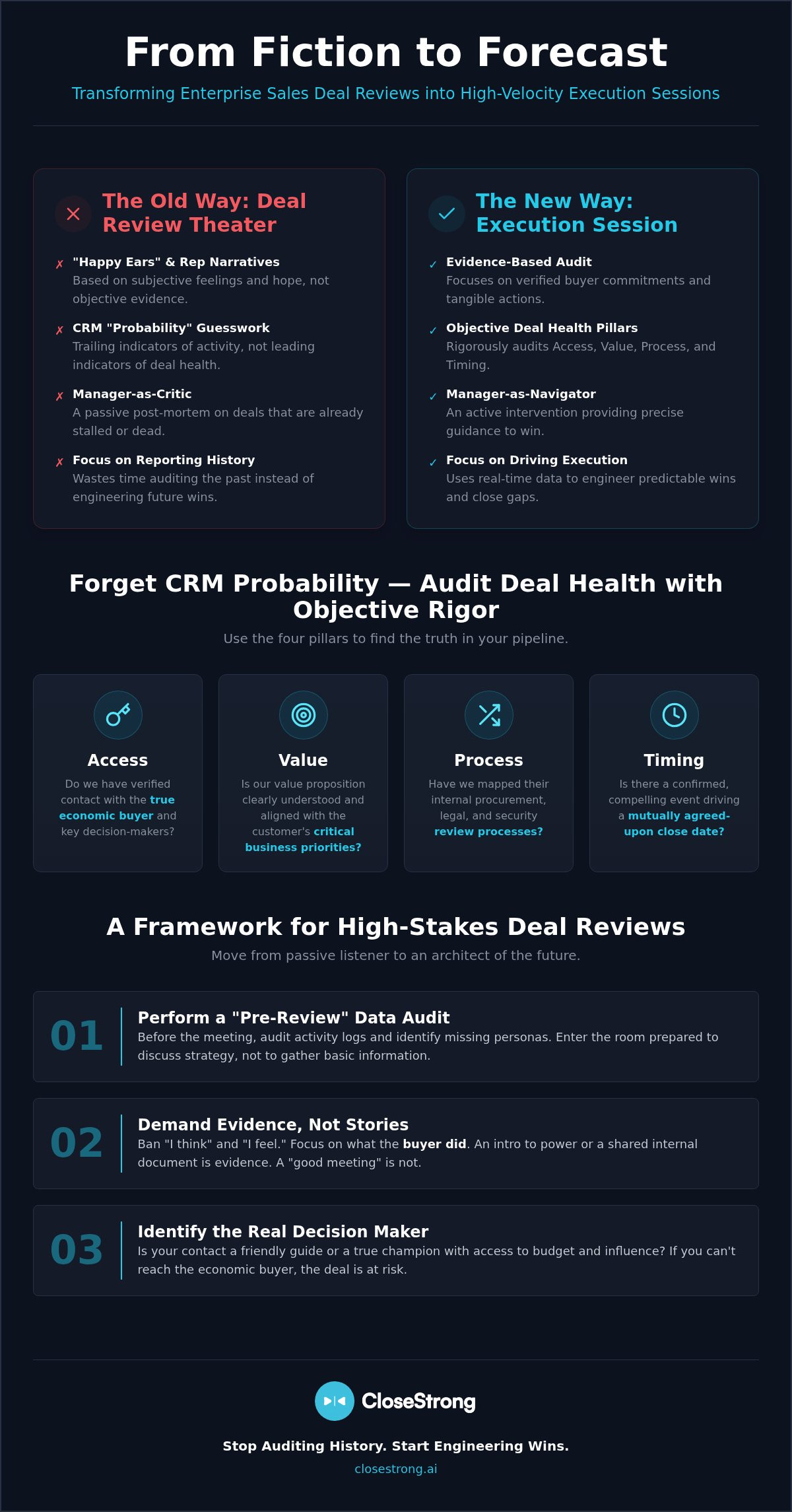
• Forget CRM "probability" percentages. Audit deal health using the four pillars of Access, Value, Process, and Timing to find the truth.
• Move from manager-as-critic to manager-as-navigator. Use Precision Guided Selling™ to give your team the exact moves they need to close.
• Bridge the execution gap. Stop talking about strategy and start using a platform designed for real-time deal execution.
Most enterprise sales deal reviews are a performance. They aren't sessions for strategy. They're sessions for fiction writing. You sit in a boardroom while a rep describes a "great" meeting that lacks a single scrap of objective evidence. You want the truth. Instead, you get "happy ears" and a forecast that slips the moment you look away. It's a waste of your leadership time and a drain on your company's revenue.
This is the "Happy Ears" epidemic. Reps don't lie because they're malicious. They lie because they're human. They mistake a polite "send me more info" for a buying signal. They mistake access to a manager for access to power. When they report these feelings in a review, they aren't giving you data. They're giving you hope. Hope is not a sales strategy. It's a liability that leads to 11th-hour slips and missed annual targets.
Your CRM isn't helping. In fact, it's likely part of the problem. A "70% probability" field is just a guess dressed up as a statistic. It’s a trailing indicator of activity, not a leading indicator of health. If your review process relies on CRM stages and rep narratives, you aren't managing a pipeline. You're watching a movie that you've already paid for but haven't seen the ending to yet.
The execution gap is the graveyard where your corporate strategy goes to die. Your leadership team spent months defining the ideal customer profile and the perfect value prop. But inside the deal review, that strategy vanishes. It's replaced by anecdotal evidence and gut feelings. The gap is the space between what your company knows it should do and what the rep is actually doing on the ground.
Traditional reviews fail because they focus on reporting rather than winning. Knowing you need to reach a C-level executive is strategy. Executing the specific path to get there is reality. When reviews don't bridge this gap, they become passive observations of failure rather than active interventions for success.
Stop looking backward. Most reviews are post-mortems performed on deals that are already dead. By the time you realize a deal is stalled, the momentum is gone. Looking at 2026 through the lens of what happened last month is a recipe for stagnation. You need to understand why enterprise deals fail before the ink dries on the rejection letter.
The shift requires moving toward real-time deal guidance. It isn't about auditing history; it's about engineering the future. You don't need more reports. You need precision. You need to move from manager-as-critic to manager-as-navigator, providing the exact moves necessary to keep a deal on the rails. It’s time to stop the theater and start the execution.
Most managers walk into enterprise sales deal reviews cold. They expect the rep to drive the narrative. They settle for being a passive listener to a rehearsed story. That's a mistake. If you're reacting to the rep's narrative, you've already lost control of the forecast. You need a framework that strips away the fluff and exposes the raw reality of the pipeline. High-stakes reviews aren't about status updates. They're about forensic audits and surgical interventions.
Preparation is the foundation. A manager must perform a "Pre-Review" data audit before the meeting even starts. Don't waste thirty minutes asking for data that should already be in your systems. Use that time for strategy. Look for the gaps in the activity logs. Identify the missing personas. When you enter the room, you shouldn't be looking for information. You should be looking for the truth. This preparation allows you to move from a reporter of history to an architect of the future.
Ban "I think" and "I feel" from your vocabulary. These phrases are the sirens of a failing deal. In high-stakes environments, evidence isn't what the rep did; it's what the buyer did. Did they share the internal procurement checklist? Did they introduce you to the economic buyer? Evidence-based selling in the enterprise is the relentless pursuit of verified buyer commitments that prove the deal is moving forward. If there's no paper trail or meeting invite, the progress is imaginary. This shift in language forces reps to stop selling to you and start selling to the customer.
Do you have a champion or just a fan? Fans like your product; champions put their reputation on the line to buy it. You need to map power with clinical precision. If your rep is only talking to the "nice" people, they're likely being walled off from the "powerful" people. Effective high stakes deal management requires uncovering the invisible stakeholders who can kill a deal from the shadows. Ask the rep: "Who loses if this doesn't happen?" If they can't name a person with a budget, you don't have a deal. You have a conversation.
Once you've stripped away the narrative, you need the "Precision Pivot." Don't give a list of ten things to do. Identify the single most critical move that unblocks the deal. Is it a meeting with Legal? Is it a value realization workshop? Find it. Then, set a hard deadline. Accountability isn't a suggestion; it's a requirement for closing. If the execution task isn't scheduled by the end of the review, consider the deal stalled. For those ready to move beyond manual audits, implementing an enterprise sales execution platform can automate the rigor your pipeline demands.
Your CRM is lying to you. Every time a rep moves a deal to "Stage 4" or assigns a "75% probability," they're guessing. These fields are designed for reporting, not for winning. In most enterprise sales deal reviews, leadership spends hours debating these arbitrary numbers. It's a waste of time. You don't need more stages. You need objective rigor. You need to look past the activity logs and find the evidence of buyer intent.
Real deal health is built on four pillars: Access, Value, Process, and Timing. If you don't have direct access to power, the deal is a gamble. If the value hasn't been quantified in the buyer's own currency, the deal is a hobby. If you don't understand the internal procurement process, the deal is a surprise waiting to happen. Finally, if there is no compelling event driving the timing, the deal is a ghost. Ghost deals are the silent killers of your forecast. They look active because emails are being exchanged, but they have zero momentum. They haunt your pipeline until the last day of the quarter, when they suddenly vanish into "closed-lost" or "slipped."
Ghosting after a demo is the most common red flag. It isn't a sign that the buyer is busy. It's a sign that you failed to establish enough value to earn their next thirty minutes. Another danger zone is the "Black Hole" of Legal and Procurement. Reps love to blame these departments for delays. Usually, the delay is actually a lack of executive sponsorship to push the paperwork through. If you want to move beyond surface-level tracking, you need to understand why basic sales deal health software often fails to capture these nuanced execution risks.
Stop accepting "the meeting went well" as an update. It’s a useless sentiment. Instead, turn that feeling into a scoreable metric. Did the buyer confirm the business case? Did they introduce the Economic Buyer? This is the ultimate litmus test. If the person who signs the check hasn't been identified and engaged, your probability isn't 90%. It's zero. Standardizing this rigor across the team requires more than just a checklist. It requires Precision Guided Selling™ that provides custom deal guidance based on real-time health scores. This isn't about micromanagement. It's about giving your reps a map so they can stop wandering and start closing.
Most sales coaching is a waste of breath. It’s too generic. It’s "be more empathetic" or "ask better questions." Those are skills for a workshop, not a boardroom. They don't close a complex deal next Tuesday. In your enterprise sales deal reviews, you need to stop coaching "how to sell" and start guiding "how to win this specific deal." It’s a fundamental shift in mindset. You aren't a teacher; you're a navigator.
The transition from manager-as-critic to manager-as-navigator is the single most important move you can make. A critic looks at what went wrong and assigns blame. A navigator looks at the obstacles ahead and provides a flight path. When you provide custom deal guidance, you remove the cognitive load from your reps. They don't have to guess what the next move is because you've already mapped it out based on objective evidence. This isn't micromanagement. It’s precision execution.
Precision Guided Selling™ is the cure for the execution gap. It transforms the review from a subjective post-mortem into a real-time intervention. Instead of talking about what the rep thinks might happen, you focus on high-quality deal guidance that reps actually follow. Why? Because it's actionable. It’s not "build more consensus." It’s "get a meeting with the Head of Infrastructure by Friday to validate the security requirements."
This level of clarity changes the energy in the room. Reps stop being defensive because the review is no longer a judgment on their character. It’s a strategy session for their success. The impact on enterprise sales outcome improvement is immediate. When you replace vague advice with surgical strikes, you reduce the time deals spend sitting in "Stage 3" waiting for a miracle. You aren't just reviewing deals; you're engineering wins.
The biggest risk to your revenue is the "Hero Culture." This is where your top two reps carry the entire quota because they "just get it." They have an intuitive sense of how to navigate power and process. But intuition doesn't scale. To hit your targets as you grow from 10 to 100 reps, you have to clone that top-performer logic. You need a system that makes the "invisible" moves of your best reps visible to everyone else.
Using an enterprise sales execution platform allows you to standardize this rigor. It ensures that every rep, regardless of tenure, follows the same high-stakes playbook. You can't be in every room. You can't sit in every review. But you can ensure that the guidance provided is consistent, evidence-based, and focused on the bottom line. Stop letting your forecast depend on individual brilliance and start relying on systemic execution. See how Precision Guided Selling™ transforms your pipeline today.
Most sales technology is just a prettier way to look at bad data. It’s a dashboard for your dysfunction. CloseStrong is the only adult in the room because we don’t care about your charts; we care about your execution. While your CRM records what happened, our Enterprise Sales Execution Platform dictates what happens next. We move the conversation from "what did they say?" to "what are we doing?"
The result of this shift is a drastic reduction in forecast variance. You stop guessing because you start measuring the only thing that matters: verified buyer action. When you close the execution gap, you stop hoping for a strong finish and start engineering it. This isn't about looking at the pipeline; it's about moving it. It's about replacing the theater of traditional enterprise sales deal reviews with the reality of precision execution.
CloseStrong replaces "feelings" with Precision Guided Selling™. In a typical review, a rep might say a deal is "looking good" because the buyer was friendly. In a CloseStrong-powered review, that same rep is held to a higher standard of evidence. We provide custom, deal-level guidance in real-time, ensuring that every move aligns with the proven path to a win. This eliminates the "happy ears" that plague your forecast and replaces them with a clinical focus on the next unblocking move.
CloseStrong bridges the strategy-execution gap by turning high-level corporate directives into deal-specific, actionable steps that reps can follow in real-time. This isn't just theory. It’s the difference between a slipped forecast and a closed-won notification. We’ve seen this transform the culture of sales organizations. They stop being reporters of history and start being architects of their own revenue success.
You don't need to wait for a new quarter to fix your process. You can start with your next meeting. If you want to stop the theater immediately, implement these three changes to your enterprise sales deal reviews:
If a rep says a meeting was "great," ask for the specific buyer commitment that proves it. No evidence means no progress.
If you don't have a confirmed path to the person who signs the check, the deal probability is zero. Stop pretending otherwise.
Every review must end with a specific execution task and a hard date for completion. Accountability is the only way to maintain momentum.
Waiting until the end of the quarter to audit your pipeline is a losing strategy. By then, the damage is done. You need visibility now. You need the ability to course-correct while there is still time to win. It’s time to move beyond the theater of traditional reviews and embrace the reality of precision execution. See the CloseStrong platform in action and start closing the gap today.
The theater is over. You can't afford another quarter of slipped forecasts and "happy ears" narratives. Effective enterprise sales deal reviews aren't about reporting what happened; they're about dictating what happens next. You've seen the framework. You know the four pillars of health. Now, it's about shifting from a critic of the past to a navigator of the future who demands objective evidence over rep intuition.
It’s time to move beyond the CRM and start using tools built for the high-stakes reality of B2B sales. Stop settling for guesswork and start relying on systemic rigor. By replacing vague coaching with Precision Guided Selling™ technology, you empower your team to navigate complex power structures and procurement black holes with clinical precision. This isn't just about better meetings. It's about enterprise-grade sales execution that delivers custom high-quality deal guidance at scale.
The execution gap is the only thing standing between your current pipeline and your revenue targets. Bridge it. Replace the fiction with a platform that prioritizes reality. Stop the theater and start closing; see CloseStrong in action. You have the map. Now, lead the way to a predictable quarter.
The primary goal is to identify hidden risks and determine the exact next move required to advance the deal toward a close. It isn't a reporting session. It's an intervention. You aren't there to hear a story about what happened last week. You're there to engineer what happens next week. Focus on unblocking the execution gap rather than auditing history.
Conduct enterprise sales deal reviews weekly for high-stakes, must-win opportunities. Monthly reviews are just post-mortems for deals that have already stalled. In complex enterprise sales, momentum is fragile. If you wait thirty days to check the health of a deal, you're just watching a slow-motion wreck. High-velocity teams review active deals frequently to ensure execution stays on the rails.
The most dangerous red flag is a lack of direct access to the economic buyer. Other warning signs include ghosting after a demo, a missing procurement timeline, or a value proposition that hasn't been quantified in the buyer's currency. If your rep is only talking to fans instead of champions, the deal is a liability. These signals indicate a lack of real momentum.
Stop accepting adjectives and start demanding evidence of buyer actions. If a rep says a meeting went "great," ask for the follow-up meeting invite or the shared internal business case. Happy ears are a symptom of subjective reporting. When you shift the focus to verified buyer commitments, the fiction disappears. It forces the rep to face the reality of the deal health.
A pipeline review is a horizontal audit of the entire funnel, while enterprise sales deal reviews are vertical deep dives into specific high-value accounts. Pipeline reviews focus on volume and stage movement. Deal reviews focus on execution and power mapping. You need both to maintain a healthy forecast, but don't confuse a status update with a surgical strategy session.
It replaces generic coaching with deal-specific, actionable guidance based on real-time data. Instead of telling a rep to "build more value," it tells them to validate the ROI with the CFO by Friday. This level of custom deal guidance eliminates the guesswork that typically plagues these meetings. It turns every manager into a high-velocity navigator of complex sales cycles.
You need a map of the decision-making unit and a list of verified buyer commitments. Don't waste time looking at CRM activity logs that show how many emails were sent. Look at the responses. Have they shared their procurement checklist? Have they confirmed the business case? If you don't have evidence of buyer engagement, you don't have a deal worth reviewing.
Frame the rigor as a path to success rather than a tool for micromanagement. Reps often resist reviews because they feel like audits. Change the culture so they see the review as a resource for winning. If a rep still resists, they're likely hiding a lack of execution. Accountability isn't optional in enterprise sales. It's the only way to ensure predictable revenue growth.


